
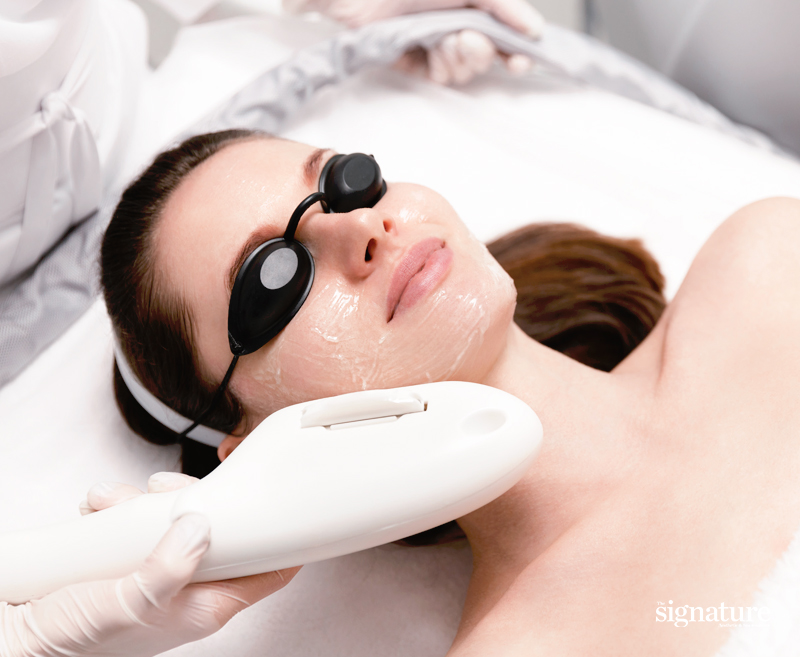
As new energy technologies emerge, lifting treatments are evolving rapidly. This article examines the key lifting technologies currently used in the beauty market and how each interacts with skin tissue.

Same Device, Different Results Anatomy of Beauty Device Energy Technology for Contour Lifting
Why do some lifting devices visibly redefine facial contours while others produce minimal change? The difference lies in the type of energy used. Facial contour is not shaped by surface-level care alone. The dermis, collagen, the SMAS (superficial musculoaponeurotic system) layer, and facial muscles all work together to create firmness and definition. Each beauty device energy technology — RF radiofrequency skin tightening, HIFU ultrasound lifting, EMS facial muscle stimulation, and microcurrent skincare devices — acts on different skin layers through distinct mechanisms. Understanding exactly how each energy type interacts with skin tissue is essential for achieving optimal results. This article provides a detailed breakdown of four core energy technologies: their mechanisms, characteristics, and key considerations for treatment.

01
The Standard for Dermal Tightening:
RF Radiofrequency Skin Tightening
RF radiofrequency skin tightening works by passing electrical current through tissue. The current meets tissue resistance, generating resistive heat. When sufficient heat accumulates in the dermis, collagen structures respond with an immediate contractile (tightening) reaction. This is followed by collagen remodeling as part of the tissue repair process.
New collagen synthesis is stimulated during this process. The skin gradually appears denser and more refined, with overall improvements in firmness. Collagen denaturation is generally understood to occur within approximately 55–70°C. During treatment, however, surface temperature is maintained between 40–45°C to prevent epidermal overheating, while selectively inducing thermal response in the dermis.
Energy delivery is categorized into monopolar, bipolar, and multipolar configurations. Monopolar RF delivers heat at greater depth and is widely used in medical-grade lifting equipment. It is also expanding into professional aesthetic settings for firmness and contour management. Bipolar RF offers comparatively precise energy control and is broadly used in aesthetic devices, including some home-use units.
Multipolar RF distributes heat uniformly across the full dermal layer with high thermal efficiency, making it suited for professional-grade equipment. In the beauty and aesthetic market, Hyper-RF — a technology that addresses the limitations of single-electrode systems — is gaining attention. It simultaneously outputs or modulates multiple frequency bands to control penetration depth and heat distribution. This allows energy to be delivered progressively from the surface to deeper layers, positioning it as an advanced iteration of conventional RF technology.
RF radiofrequency skin tightening is primarily used for dermal tightening care: reducing the appearance of enlarged or sagging pores, improving fine lines, and enhancing overall skin firmness. With repeated use, skin appears more compact and refined, with a noticeable tightening sensation and smoother pore texture. Because results tend to accumulate over time, maintaining a consistent post-treatment routine centered on hydration and antioxidants helps sustain the collagen remodeling environment.
Recommended for:
- Noticeable overall decrease in skin firmness
- Vertically elongated pores or early-stage skin laxity

02
Designing Surface Density and Tightening:
Microwave Energy
Microwave-band electromagnetic waves induce vibration in water molecules within tissue. The resulting heat drives skin response. Unlike RF radiofrequency skin tightening — which uses resistive heat generated by electrical current — microwave energy is absorbed directly by tissue to generate heat.
Depending on handpiece design and output settings, energy can be delivered selectively from the surface down to the subcutaneous fat layer. Target depth and heat distribution vary according to treatment purpose. When thermal stimulation reaches collagen fibers, a temporary contractile response may occur. In some cases, thermal responses within the subcutaneous fat layer may contribute to localized volume changes or body silhouette refinement. In areas with a thicker subcutaneous fat layer — such as the abdomen or thighs — the technology can be applied to target deeper tissue. The actual range and depth of tissue response, however, varies depending on output level, irradiation method, and skin hydration status.
Microwave-based devices are used for a range of purposes, from skin density tightening to body contouring targeting the subcutaneous fat layer. Leveraging their ability to deliver energy across comparatively broad areas, newer devices are emerging with subdivided energy intensity and application depth settings for more customized treatment.
Recommended for:
- Uneven or rough overall body surface requiring refinement
- Body or localized area contouring as part of a combined treatment plan
03
The Core of Deep Lifting:
HIFU Ultrasound Lifting
HIFU ultrasound lifting focuses ultrasound energy to a single point at a specific depth, creating a localized thermal coagulation point (TCP). Its defining feature is the ability to selectively induce a thermal response at a target depth — the sub-dermis or SMAS layer — while minimizing direct epidermal damage. Protein denaturation and tissue contraction occur at the site of thermal coagulation, followed by collagen remodeling. This thermal coagulation response is generally understood to be induced at approximately 60°C or above. However, the actual range and depth of tissue response varies depending on device output, cartridge depth, irradiation density, and individual skin thickness.
Devices are often designed with cartridges targeting different layers: approximately 1.5mm (upper dermis), 3.0mm (lower dermis), and 4.5mm (SMAS-adjacent layer). Home-use HIFU devices are engineered with safety in mind, using more conservative energy settings or distributed irradiation patterns.
HIFU ultrasound lifting is primarily used to address contours blurred by gravitational laxity — the lower face, jawline, and double chin. With consistent use, the jawline appears more defined and the lower facial contour becomes more distinct. Results are gradual rather than immediate. Individual variation exists, but changes typically become apparent from around 2–3 months of use. This full period should be understood as part of post-treatment care. Maintaining consistent sun protection and a hydration- and antioxidant-focused routine throughout is important.
Recommended for:
- Early loss of definition along the lower facial line
- Skin requiring elasticity management focused on deep structure rather than surface treatment

04
Muscle Tone Correction and Volume Enhancement:
EMS Facial Muscle Stimulation
EMS facial muscle stimulation delivers low- or mid-frequency electrical current to motor nerves, inducing involuntary muscle contractions. Originally used in rehabilitation and muscle stimulation applications, this technology has been widely adapted for facial muscle management devices.
Facial EMS can induce repeated contraction and relaxation of the facial muscles, increasing muscle activation and temporarily influencing blood flow and microcirculation. The degree of contour change and lifting perception varies depending on individual muscle condition, frequency of use, stimulation intensity, and skin thickness. Recent devices increasingly use mid-frequency (kHz) currents to reduce surface-level stimulation while improving delivery efficiency to deeper muscle layers.
Where RF radiofrequency skin tightening and HIFU ultrasound lifting are designed to generate thermal responses in skin tissue, EMS facial muscle stimulation takes a different approach — conditioning the underlying muscles themselves to refine the overall facial impression. Consistent use has been associated with a more defined facial line and a firmer appearance in the cheek area, though ongoing maintenance is required. Use of 2–3 times per week is generally recommended, with adequate rest time between sessions for muscle recovery rather than daily consecutive use.
Recommended for:
- Facial definition appearing less distinct due to reduced facial muscle engagement
- Strengthening an overall face-conditioning maintenance routine
05
Low-Intensity Current-Based Conditioning:
Microcurrent Skincare Device
Microcurrent skincare devices use extremely low-intensity current measured in microamperes (μA). Operating at a far lower intensity than EMS, stimulation is either imperceptible or very subtly felt. Unlike EMS — which induces strong muscle contractions — microcurrent supplements the body’s own bioelectrical current at a comparable level, focusing on supporting intrinsic cellular activity. Some studies suggest microcurrent may influence ATP production, cellular metabolism, and tissue recovery responses, though a significant portion of existing evidence is derived from animal and tissue-based research. Actual effect range and perceived intensity therefore vary depending on device characteristics, conditions of use, and individual skin status.
The key advantage of a microcurrent skincare device is its low stimulation intensity, making it easy to incorporate into a daily routine. It pairs well with higher-energy devices such as RF radiofrequency skin tightening or HIFU ultrasound lifting, and works effectively as a standalone routine for daily conditioning or as a supportive treatment to stabilize skin after procedures. Consistent use may help reduce recurring morning puffiness and promote more even, refined skin condition over time. Prior to use, ensuring the skin is sufficiently hydrated — and using a conductive gel to aid current delivery — helps transmit current to the skin more stably. Maintaining gentle, consistent contact with the skin at an even pace is the foundational principle.
Recommended for:
- Preference for a low-impact, daily routine-based treatment approach
- Maintaining skin condition or supporting complementary use alongside other devices

Precision Aftercare: Completing the Results of Your Contour Lifting Device
Contour and lifting treatments using heat-generating devices require aftercare as important as the treatment itself. Allowing the treated tissue to stabilize and recover without interference is essential to preserving results. Because thermal-based and electrical stimulation-based devices operate through different mechanisms, aftercare considerations differ accordingly.
01
The Most Sensitive Moment: Immediately After Lifting
For thermal-energy devices such as RF radiofrequency skin tightening and HIFU ultrasound lifting, the critical care window runs from immediately post-treatment through approximately 72 hours. During this period, skin cells interpret the thermal stimulus as injury and initiate regenerative signaling, activating the collagen remodeling process. Sudden temperature fluctuations during this phase may slow the regenerative response. It is advisable to avoid environments that rapidly elevate core body temperature — such as saunas, intense exercise, or prolonged hot baths — for a defined period after treatment. Rapid changes in cutaneous blood flow can prolong the perception of redness or swelling. The same applies to excessive cooling. If redness relief is needed, brief and intermittent application is the safer approach.
02
After Electrical Stimulation Devices: Muscle and Skin Recovery Rhythm
EMS facial muscle stimulation and microcurrent skincare devices cause less surface-level skin irritation than thermal-based devices. That said, temporary muscle fatigue or tension may be felt immediately after EMS use, and dryness may occur at sites where conductive gel was applied. Microcurrent use may cause mild redness at the treated area, which typically subsides within a few hours. For both devices, replenishing fluids and reinforcing moisturization immediately after use helps stabilize skin condition. During skincare application, pressing rather than rubbing product into the skin is recommended.
03
The Barrier Recovery Routine That Preserves Lifting Results
Skin may become temporarily drier or more sensitive immediately after treatment. During this period, products containing barrier lipid-replenishing ingredients — ceramides, cholesterol, fatty acids — along with moisture-retaining agents such as panthenol and hyaluronic acid, are beneficial. Applying serums containing vitamin C, amino acids, or peptides — which serve as building blocks for collagen synthesis — may provide a synergistic effect that supports remodeling efficiency. Note that highly acidic or high-concentration vitamin C formulations may irritate sensitized skin; starting with derivative forms is the safer approach. Alcohol should be avoided during recovery, as it promotes vasodilation and diuretic effects that can deplete skin moisture.
04
Minimizing Irritation and UV Defense During Recovery
Exfoliating actives such as retinoids, AHAs, and BHAs can burden sensitized post-treatment skin. Reducing or discontinuing their use for a defined period is recommended, with gradual reintroduction as skin condition stabilizes. Products containing fragrance, alcohol, or high-concentration essential oils may also trigger irritation or allergic responses in the early recovery phase and should be minimized until skin has stabilized. Sun protection is among the most critical aftercare priorities. Excessive UV exposure during the skin’s recovery process increases the risk of post-inflammatory hyperpigmentation (PIH) and may upregulate matrix metalloproteinase (MMP) activity — enzymes associated with collagen degradation. Consistent use of SPF 30 or higher sunscreen is essential.
REFERENCE
1. Szmyt M, et al. The Landscape of Radiofrequency Technology for Skin Rejuvenation. Health Science Reports. 2025.
2. Chen Y, et al. Development of Home Beauty Devices for Facial Rejuvenation: Establishment of Efficacy Evaluation System. Clinical, Cosmetic and Investigational Dermatology. 2024.
3. Jonik S, Rothka AJ, Cherin N. Investigating the Therapeutic Efficacy of Microcurrent Therapy: A Narrative Review. SAGE Open Medicine. 2025
Editor JIWON, YANG
Image Shutterstock
The Signature Magazine – April 2026 Issue